How to Practise Outdoor Skills at Home
You do not need to spend every weekend in the woods to become better at bushcraft. You do not even need access to a campsite, a large garden or expensive outdoor equipment to begin learning useful skills.
Many of the abilities that make someone more capable outdoors can be practised at home. You can learn knots at the kitchen table, improve your navigation skills using a map, study plants through a field guide, practise packing your rucksack and develop a better understanding of weather, shelter and fire safety.
The advantage of practising at home is simple: you can learn the basics without the pressure of cold hands, poor weather or unfamiliar surroundings. When you eventually take those skills outdoors, you will already understand the principles and have some experience of putting them into practice.
At Pure Bushcraft, the aim is not to turn you into someone who can only follow instructions from a guide. It is to help you develop the knowledge, confidence and judgement to make good decisions outdoors.
Here are practical ways to start building those skills at home, even if you are a complete beginner.
1. Learn Knots and Cordage Skills
Knot tying is one of the easiest bushcraft skills to practise at home, and you can make progress with very little equipment.
A short length of rope or paracord is enough to get started. If you do not have either, ordinary string can help you learn the basic movements, although it behaves differently from thicker cordage.
Start by learning a small number of useful knots rather than trying to memorise dozens at once and becoming overwhelmed.
Knots worth learning first
Figure-Eight Knot: Learn how to tie this simple stopper knot and recognise its shape. It is also the basis of several other knots used in climbing and rope systems, although a basic figure-eight stopper knot should not be treated as a climbing attachment.
Bowline: Practise forming a fixed loop that does not tighten under ordinary loading. Learn how the knot is constructed and how to inspect it after tying.
Clove Hitch: Learn how to attach a line to a suitable post or pole. Experiment with how the hitch behaves when tension changes.
Taut-Line Hitch: Practise tying an adjustable hitch that can help maintain tension in a suitable line, such as a lightweight tarp guyline.
Round Turn and Two Half Hitches: Learn a useful method of securing a line around an appropriate fixed object.
The purpose is not simply to remember the names. You should understand how each knot is formed, what it is useful for and where it may be unsuitable.
How to practise effectively
Tie each knot slowly while looking at the instructions. Once you understand the sequence, repeat it without looking.
Then try tying it from a different position or with the cord held at a slightly different angle. This helps you understand the structure rather than relying entirely on muscle memory.
Check each knot before applying tension. Make sure the strands follow the intended path and that the finished knot matches a reliable reference.
Home challenge: Choose one knot and tie it correctly five times in succession without referring to the instructions. The following day, see whether you can repeat the process from memory.
2. Improve Your Map and Compass Skills
Navigation is an excellent skill to practise at home because you can learn much of the theory before ever setting foot on a trail.
If you own a map of your local area, spread it out on a table and begin identifying the features it shows.
Look for roads, footpaths, streams, woodland, hills and other recognisable features. Compare the map with places you already know and see how accurately you can locate them.
Learn to read a map
Start with the basics:
- Understand the map scale.
- Learn what common symbols represent.
- Identify contour lines and how they show changes in elevation.
- Recognise grid references.
- Practise measuring distances along a route.
- Learn how to orientate the map.
Contour lines are particularly useful. Closely spaced lines indicate a steeper slope, while widely spaced lines generally indicate gentler ground.
Understanding these patterns helps you anticipate the terrain before you reach it.
Practise using a compass
Place a compass on your map and practise orientating the map correctly.
Learn how to take a bearing between two points and understand the difference between grid north and magnetic north.
You can draw a short imaginary route across the map, measure its direction and calculate its approximate distance. Then repeat the exercise with a different destination.
Remember that map and compass navigation involves more than following a bearing. You must also consider terrain, obstacles, access rights and whether the intended route is safe.
Home challenge: Plan a short walk using a map of a familiar area. Identify three features you expect to encounter and estimate the distance between them. When you eventually walk the route, compare your predictions with what you find.
3. Practise Shelter Skills Without Building a Shelter
Shelter building is often associated with cutting branches, collecting natural materials and constructing something in the woods. However, there is plenty you can learn at home before attempting any of that.
Begin by understanding what makes a shelter effective.
A good shelter should help protect you from rain, wind and heat loss while providing enough space for its intended purpose. Its design must also suit the weather, terrain and materials available.
Learn how tarps work
If you own a tarp, practise spreading it out in your garden or another suitable space.
Experiment with different layouts, such as:
- A simple sloping shelter.
- An A-frame arrangement.
- A basic lean-to.
- A low-profile pitch designed to reduce exposure to wind.
Use existing supports or suitable poles where available. Avoid climbing onto structures, attaching lines to unsafe objects or creating tension that could damage property.
Observe how changing the angle affects the covered area and where rainwater would run off.
A shelter that looks impressive may still allow water to pool or wind-driven rain to enter.
Understand shelter site selection
Even if you cannot build outdoors, study the characteristics of a good campsite.
Learn why low-lying hollows may collect cold air or water, why exposed ridges can be uncomfortable in strong winds, and why camping beneath dead or unstable branches can be dangerous.
Consider drainage, wind direction, access, ground conditions and the effect your presence might have on the environment.
Home challenge: Draw three different tarp pitches. For each one, write down the conditions it might suit, its limitations and the equipment needed to construct it safely.
4. Learn Fire Lighting Principles Safely
Fire lighting is a valuable outdoor skill, but it is not something you should practise indoors with open flames.
You can still learn a great deal at home without lighting a fire.
Start by understanding the three elements required for combustion: heat, fuel and oxygen. Learn how they interact and why a fire may fail if one element is missing.
Then study the characteristics of different natural tinder and fuels.
Understand the different stages of a fire
A successful fire lay usually develops from small, easily ignited material towards progressively larger fuel.
Learn to distinguish between:
Tinder: Fine material that can catch an ignition source and produce a flame.
Kindling: Small, dry pieces that help a flame grow beyond the initial tinder.
Larger fuel: Progressively bigger pieces of suitable wood that maintain a more substantial fire.
The precise materials required depend on the conditions and ignition method.
Study natural fire materials
Use photographs, field guides and your existing Pure Bushcraft articles to learn about materials such as birch bark that has already fallen naturally, dry grasses, dead twigs and other potential tinder sources.
Understand the importance of dryness, preparation and responsible collection.
Do not strip bark from living trees or assume that deadwood can be collected wherever you find it.
If you eventually practise fire lighting outdoors, do so only where fires are permitted, with suitable precautions and a safe means of extinguishing the fire. Follow the land manager’s rules and local restrictions.
Home challenge: Draw a fire lay and label the tinder, kindling and larger fuel. Explain why each stage needs to be prepared appropriately before ignition.
5. Learn to Recognise Useful Plants
You do not need to gather wild plants to start learning about them.
A field guide, reliable reference website or botanical identification resource can help you become familiar with the plants you may encounter on future walks.
Start with a few common British species rather than attempting to identify everything at once.
The Pure Bushcraft Reference Library is a useful place to begin exploring plant identification and traditional uses.
What should you learn about each plant?
For every species you study, try to understand:
- Its common and scientific names.
- Its typical habitat.
- The shape and arrangement of its leaves.
- Its flowers, fruits or other seasonal features.
- The time of year when it is easiest to identify.
- Its traditional uses, where reliably documented.
- Potential hazards and poisonous lookalikes.
- Whether collection is appropriate and lawful.
Silver birch, hazel, common dandelion, bramble and stinging nettle are useful examples to study because they have distinctive features and are widely discussed in British natural history and bushcraft.
However, never assume a plant is safe to eat simply because it resembles a familiar species. Photographs alone may not reveal every feature needed for a confident identification.
Learn without harvesting
Look at photographs of the same plant throughout the year. Notice how its appearance changes between new growth, flowering, fruiting and winter.
You can also practise drawing a leaf or recording identification features in a notebook. The aim is to train your eye to notice details that you might otherwise overlook.
Home challenge: Choose one native British plant and write a short identification sheet containing at least five distinguishing features, its habitat and one important safety consideration.
6. Practise Outdoor Equipment Preparation
A bushcraft trip can become uncomfortable very quickly if you forget an essential item or discover that your equipment does not work as expected.
Packing and checking your equipment are skills in their own right.
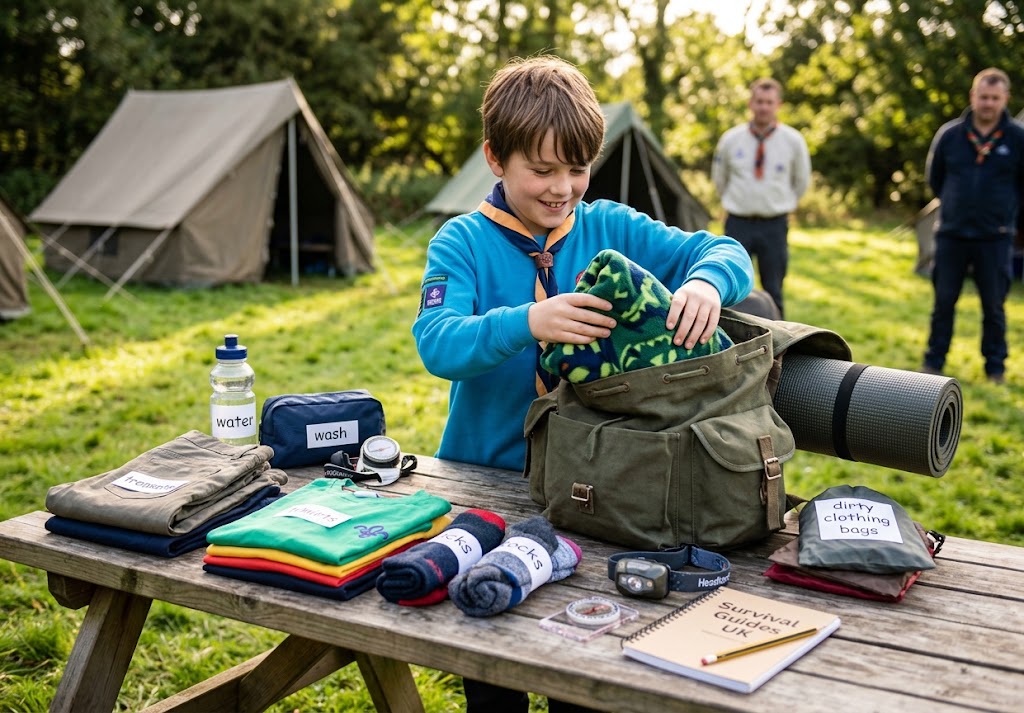
Start by laying out the equipment you would take on a short outdoor session. This might include suitable clothing, water, food, navigation tools, a first-aid kit and shelter equipment, depending on the activity.
Build a practical packing system
Group equipment according to its purpose.
For example:
- Navigation and communication.
- Shelter and sleep equipment.
- Food and water.
- First aid and emergency equipment.
- Clothing and weather protection.
- Activity-specific tools.
Think about which items you might need quickly and which can remain packed until you reach your destination.
Keep essential emergency equipment accessible rather than burying it at the bottom of a rucksack.
Test your equipment before you need it
Check that buckles work, zips run properly and straps are not damaged.
If you carry a water filter, understand its instructions and limitations. If you own a compass, make sure you know how to use it. If you carry a head torch, check its operation and power supply.
Do not wait until you are outdoors to discover that you cannot operate something you have packed.
Home challenge: Pack a rucksack for a planned day walk. Make a list of everything you included, then unpack it and consider whether each item was necessary, accessible and suitable for the conditions.
7. Learn Weather Awareness
Understanding the weather helps you make better decisions about clothing, shelter and whether an outdoor activity should go ahead.
You can develop this skill by checking a forecast regularly and comparing it with the conditions you observe.
Learn the difference between temperature, wind speed, wind direction, precipitation and cloud cover.
Pay attention to how wind chill can increase heat loss and how rain can make clothing and equipment wet, heavy or uncomfortable.
Study the forecast before a walk
Look at the forecast for a specific location rather than relying on a general regional summary.
Consider how conditions might change during the day. A calm morning does not guarantee calm conditions later.
Learn to recognise warnings for strong winds, heavy rain, thunderstorms, snow or other hazardous conditions.
For hillwalking and remote trips, use appropriate specialist forecasts where available and understand their limitations.
Keep a weather notebook
Record the forecast and the conditions you actually observe.
Over time, you may notice patterns between cloud development, wind changes and incoming rain. This can improve your awareness, although observation should complement rather than replace reliable forecasts.
Home challenge: For seven days, record the forecast for your area and compare it with the actual conditions. Note where the forecast was accurate and where conditions differed.
8. Learn to Tie and Manage Camp Cordage
Beyond individual knots, bushcraft requires you to handle cordage efficiently.
A tangled line wastes time and can become frustrating when you are trying to put up a tarp or secure equipment in poor weather.
At home, practise coiling cord neatly, securing it for storage and uncoiling it without creating knots.
Learn to inspect cordage for wear, cuts, fraying and other damage.
You can also practise attaching lines to suitable fixed objects and adjusting tension without over-tightening them.
Remember that different cords have different strengths and limitations. Never assume that paracord or ordinary camping cord is suitable for climbing, rescue or supporting a person’s weight.
Home challenge: Take a length of cord, coil it neatly and secure it so that it can be stored without unravelling. Repeat until you can do it consistently without tangles.
9. Develop Your Outdoor First-Aid Knowledge
You can learn important first-aid principles at home, although practical training is valuable and should not be replaced by reading alone.
Start by learning how to recognise common outdoor problems, including blisters, minor cuts, sprains, heat-related illness and cold-related illness.
Understand when an injury can be managed with basic first aid and when urgent medical help is required.
Become familiar with your first-aid kit
Open your kit and identify the contents.
Learn what each item is intended to do, check expiry dates where relevant and replace anything that is damaged or missing.
Make sure you understand the instructions for the products you carry.
You should also know how to summon help and communicate your location. If you spend time in remote areas, learn how to provide a useful grid reference and understand the limitations of mobile phone coverage.
For a more structured approach, consider completing a recognised outdoor first-aid course.
Home challenge: Choose a hypothetical outdoor emergency, such as a blister developing several miles from the nearest road. Write down the steps you would take to manage the problem, decide whether to continue and seek help if necessary.
10. Practise Bushcraft Problem-Solving
Bushcraft is not simply a collection of techniques. It involves choosing the right technique for the situation and recognising when a plan needs to change.
You can practise this way of thinking without leaving home.
Create a realistic scenario and work through your options.
For example:
Scenario: You arrive at a planned camping area and discover that the ground is waterlogged.
Ask yourself:
- What does the weather forecast suggest about conditions later?
- Is there a suitable alternative location where camping is permitted?
- Can you choose a safer route without crossing hazardous terrain?
- Do you have enough daylight to change your plan?
- What would you do if no suitable alternative were available?
Try another scenario:
Scenario: You are preparing to leave for a day walk when the forecast changes to heavy rain and strong winds.
Consider whether your equipment is suitable, whether the route remains appropriate and whether postponing the trip is the better decision.
These exercises encourage you to think beyond a single skill and consider how navigation, shelter, clothing, weather and judgement work together.
Home challenge: Write three outdoor scenarios and list the safest practical response to each. Include at least one situation where the best decision is to stop, change plans or turn back.
11. Build a Simple Home Bushcraft Training Routine
You do not need to spend hours practising every day. Short, regular sessions are often easier to maintain than an ambitious plan that becomes difficult to follow.
Here is a simple weekly routine you can adapt to your time and equipment.
|
Day |
Skill |
Practice |
|---|---|---|
|
Monday |
Knots |
Learn or revise one useful knot. |
|
Tuesday |
Navigation |
Read a map and practise taking a bearing. |
|
Wednesday |
Plant knowledge |
Study one British plant and its identifying features. |
|
Thursday |
Equipment |
Check, organise or pack your outdoor kit. |
|
Friday |
Weather |
Study the forecast and record your observations. |
|
Saturday |
Practical skills |
Practise a tarp pitch, cordage management or another suitable skill. |
|
Sunday |
Review |
Test what you remember without looking at your notes. |
You can complete many of these sessions in 10–20 minutes.
The important part is consistency. Repeating a skill and testing your memory will usually be more useful than reading about dozens of techniques once and never practising them again.
12. Turn Home Practice into Real Outdoor Experience
Home practice is a starting point, not a complete replacement for learning outdoors.
Some skills depend on conditions that are difficult to reproduce at home. Reading a map at a table is different from navigating through woodland in poor visibility. Understanding shelter design is different from pitching a tarp in strong wind. Studying plant photographs is different from identifying a plant in the field.
Once you are comfortable with the basics, put your knowledge into practice in suitable outdoor settings.
Start with familiar locations, manageable activities and conditions appropriate to your experience.
Follow access rules, respect landowners and wildlife, and make sure you have suitable equipment for the activity.
After each session, consider what went well, what you found difficult and what you should practise next.
That process of learning, testing and improving is at the heart of developing reliable bushcraft skills.
Final Thoughts
You do not have to wait for a camping trip, a woodland visit or a free weekend to improve your outdoor skills.
A length of cord, a map, a notebook and a little time can provide the foundation for meaningful practice. You can learn knots, improve navigation knowledge, study useful plants, understand weather, prepare equipment and develop the judgement that helps you make better decisions outdoors.
Start with one skill, practise it regularly and build from there.
When you eventually head outside, you will have more than information in your head. You will have already started turning that information into knowledge you can use.
Explore more with Pure Bushcraft: Browse the Outdoor Skills Challenges and Reference Library to find your next skill to learn, practise and put to the test.
🔒Ready to test your survival skills?
Join Pure Bushcraft for free, complete challenges, earn badges and increase your Survival Level.
JOIN FREE →
CRAIG BURR
FOUNDER · PURE BUSHCRAFT
I'm Craig, the person behind Pure Bushcraft. I created Pure Bushcraft because I wanted somewhere people could learn real outdoor skills in a practical, straightforward way — from lighting a fire and tying knots to navigation, campcraft and everything in between.
You can read more about the story behind Pure Bushcraft here as well as our approach here.