Pure Bushcraft Outdoor Skills Challenge 91: Walk 2km by Moonlight
Walking outdoors after dark changes how you experience even a familiar route. Shapes become harder to distinguish, distances can be deceptive and uneven ground is less obvious. Moonlight can provide enough illumination to see some features, but it is highly variable and should never be treated as a dependable substitute for a torch.
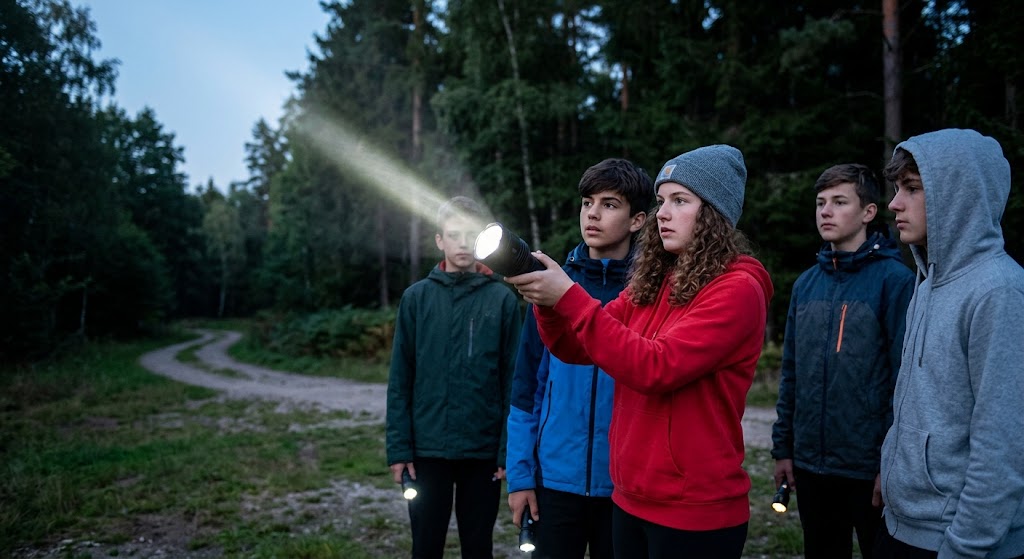
For this challenge, you’ll plan and complete a two-kilometre walk in suitable conditions, relying on moonlight for your route observation while carrying a torch for safety. The aim is to understand the limitations of natural light and develop better judgement, not to prove that you can manage without emergency equipment.
Your Challenge
Complete a 2km walk using only moonlight to illuminate the route, in a familiar, safe area where walking after dark is permitted.
Choose a route that you have already walked in daylight. It should be level, free from traffic, away from water and steep drops, and have a clear surface without significant obstacles. A private garden, enclosed field with permission or suitable open area may be more appropriate than a public footpath with hazards.
The moonlight must be your only light source for observing the route during the challenge. However, you must carry a working torch or headtorch and use it immediately if you cannot see the ground safely, become disoriented, encounter an unexpected hazard or need to stop and reassess. If you need to use it, stop the moonlight-only attempt and record that the conditions were not suitable to complete the challenge as intended.
Do not attempt this walk on roads, beside cliffs, across tidal areas, near deep water or on exposed terrain. Never walk into unsafe conditions simply to complete a challenge.
What You’ll Need
- A familiar, permitted route measuring 2km
- Weather-appropriate clothing and footwear
- A fully charged phone for emergencies
- A working torch or headtorch, kept accessible
- A small first-aid kit
- A companion if you are inexperienced with night walking
- A way to record your route and observations
Check the weather forecast, ground conditions and moonrise and moonset times before leaving. A bright moon does not guarantee good visibility: cloud, mist, tree cover and surrounding buildings can reduce the available light significantly.
Tell someone where you are going and when you expect to return. If you are walking with another person, agree that safety takes priority over completing the challenge without artificial light.
Take the Challenge
1. Choose a Suitable Route
Plan your route in daylight and measure it using a map, mapping tool or known distance markers. The total distance should be two kilometres, ideally as a simple out-and-back route on familiar ground.
Avoid routes that depend on crossing roads, negotiating stiles in darkness, passing through dense woodland or following a narrow path beside water. Even a route that feels straightforward during the day can become difficult at night.
Walk the route in daylight first if you haven’t used it recently. Note any gates, uneven patches, changes in surface and places where the path becomes less obvious.
If you cannot find a safe, suitable route, postpone the challenge. The right location matters more than the date you complete it.
2. Check the Moon and Weather
Moonlight depends on the moon’s phase, its position in the sky and the surrounding conditions. A bright, high moon can illuminate an open area quite well, while a low moon or heavy cloud may leave the same place very dark.
Choose a night when the moon is above the horizon and the forecast suggests reasonable conditions. Avoid fog, heavy rain, icy surfaces and strong winds that could make walking hazardous.
Remember that trees, buildings and hills can block the moonlight even when the sky is clear. A route that crosses from an open field into a wooded area may become much darker without warning.
3. Prepare Before Setting Off
Put on suitable footwear and clothing, and check that your phone and emergency light work. Keep the torch somewhere you can reach immediately without unpacking your bag.
Explain the route and expected return time to anyone who is not joining you. If walking with a companion, stay together and agree that either person can stop the activity at any point.
Before starting, take a moment to observe how much of the route you can see. Can you distinguish the path from the surrounding ground? Can you identify obstacles and changes in surface? If not, conditions are already too dark for a safe moonlight-only attempt.
4. Begin the Walk Slowly
Start at a comfortable pace and allow your eyes time to adjust to the low light. Avoid staring at bright screens or using your torch unless safety requires it.
Look for broad features such as the edge of a path, a hedge line or a clear boundary between open ground and vegetation. Do not assume that a dark shape is a safe place to step. If you cannot distinguish the ground clearly, stop and use your torch.
Take shorter steps than you might during daylight, especially on grass, gravel or uneven surfaces. Keep your attention on the route ahead and avoid walking while looking at the moon or stars.
The purpose is to notice how your perception changes in low light, not to push through uncertainty.
5. Observe How Moonlight Affects Visibility
As you walk, pay attention to what you can and cannot see.
In open ground, the moon may create enough contrast to distinguish large features and the general shape of the route. Under trees, shadows can hide holes, roots and changes in surface. Wet ground may reflect light differently from dry ground, while low cloud can make the surroundings appear much darker.
Notice whether you can judge distances accurately. Objects may seem closer or further away than they really are, particularly when there are few familiar features to provide scale.
You should never rely on moonlight to identify hazards that are too small or subtle to see. If you cannot see where you are placing your feet, use your torch and end the moonlight-only attempt.
6. Complete the 2km Route
Continue at a controlled pace, keeping track of your progress and remaining within the safe route you planned.
On an out-and-back route, turn around at the halfway point and retrace your steps. Do not extend the walk to find a darker area or take an unfamiliar shortcut.
If conditions deteriorate, clouds cover the moon, you become unsure of your location or you encounter an unexpected hazard, use your torch and stop the challenge. Return by the safest available route.
There is no penalty for deciding that the conditions are unsuitable. Sound judgement is a core outdoor skill, particularly when visibility is limited.
7. Review Your Experience
Once you have returned safely, record how the walk felt compared with the same route in daylight.
Think about which features remained visible, where shadows caused difficulties and whether your walking pace changed. Consider how weather, vegetation and the moon’s position influenced your experience.
If you used your torch for safety, record that honestly. You can repeat the challenge on a better night rather than pretending the route was completed under moonlight alone.
Check Your Results
Use these questions to assess your attempt.
Did you complete the full 2km? Check your planned route or distance record rather than estimating the distance from time alone.
Could you distinguish the route safely? You should have been able to see enough of the ground to place your feet confidently without stepping into unknown areas.
Did you recognise changing conditions? Think about how cloud, shadows, trees and the moon’s position affected visibility.
Did you keep emergency equipment available? A responsible night walker carries a torch and knows when to use it.
Did you make sensible decisions? Turning back or using a light when visibility becomes unsafe is good judgement, not failure.
If you were unable to complete the route safely using moonlight alone, consider the attempt a useful learning experience. Choose a safer route or wait for more suitable conditions before trying again.
Complete the Challenge
You’ve completed this challenge when you have walked the full two-kilometre route in conditions where moonlight alone provided adequate visibility, while keeping an emergency light available and following your safety plan.
You should be able to describe how the moonlight affected your perception and identify at least one way in which night walking differs from walking in daylight.
If you needed your torch because conditions became unsafe, do not claim the moonlight-only attempt as complete. Review what happened and try again under safer conditions. Your judgement and honesty matter more than a completed checklist.
How to Submit Your Challenge
Share your evidence on your Pure Bushcraft member profile for verification.
Submit your evidence
- Log in to your Pure Bushcraft account.
- Open your member profile and select Social Activity.
- Upload a photograph taken before or after the walk, or a photograph of your route notes.
- Include the distance and a short description of the conditions, then add #Pure BushcraftChallenge91.
- Share the post for verification.
Your evidence does not need to show you walking in darkness. A clear record of your route and observations is more useful than attempting to photograph yourself on a dark path.
Challenge 91 Checklist
Want to Push Yourself?
Repeat the route under different moon conditions. Compare a clear night with a night when thin cloud reduces the available light, but only attempt the walk when the route remains safe. Record how much the conditions affect visibility.
Compare open ground and tree cover. From a safe, stationary position, observe how visibility changes when the moon is unobstructed and when trees cast shadows. Do not extend your walk into hazardous areas to make this comparison.
Practise low-light observation. Learn to notice broad route features without assuming you can see every obstacle. Compare your observations with what you discover in daylight, and identify any hazards that were difficult to detect.
Improve your night-walking preparation. Refine your route plan, pack organisation and emergency-light access. The more consistently you prepare, the easier it is to make sensible decisions when conditions change.
Learn when not to continue. An important part of night navigation is recognising when natural light is insufficient. A good outdoor practitioner knows when to stop, use a light or return by a safer route.
What’s Next?
Continue developing your outdoor skills with Pure Bushcraft Outdoor Skills Challenge 90: Identify Five Constellations and Use Them to Find North. That challenge introduces you to useful star patterns and shows how Polaris can help you estimate the direction of true north.
You can complete Pure Bushcraft Outdoor Skills Challenges in any order, so choose the next activity that interests you and keep building your skills through practice.
Once you’ve shared your evidence and it has been verified, the Pure Bushcraft Outdoor Skills Challenge 91 is complete and the completed challenges figure will be updated on your profile.
🔒Ready to test your survival skills?
Join Pure Bushcraft for free, complete challenges, earn badges and increase your Survival Level.
JOIN FREE →
CRAIG BURR
FOUNDER · Pure Bushcraft
I'm Craig, the person behind Pure Bushcraft. I created Pure Bushcraft because I wanted somewhere people could learn real outdoor skills in a practical, straightforward way — from lighting a fire and tying knots to navigation, campcraft and everything in between.
You can read more about the story behind Pure Bushcraft here as well as our approach here.