SGUK Outdoor Skills Challenge 72: Make a Ground Insulation Layer from Fallen Leaves and Test It
The ground can draw heat away from your body surprisingly quickly, even when the air temperature does not feel particularly cold. A thick layer of dry leaves can help trap air beneath you, creating insulation between your body and the ground. In this challenge, you will build a temporary leaf layer, compare it with bare ground and assess how well it works.
Your Challenge
Make a temporary ground insulation layer using naturally fallen leaves, then test it by comparing how the ground feels through the layer and directly beneath it.
You will be assessing the usefulness of the material, not trying to prove that leaves alone make a safe sleeping system. Never rely on loose leaves as your only insulation in cold or wet conditions.
What You’ll Need
- A supply of naturally fallen leaves gathered from a suitable area
- A groundsheet or waterproof sit mat to use as a consistent base for testing
- A second identical mat, if available
- A watch or timer
- A notebook or phone to record your observations
- Suitable outdoor clothing for the weather
Choose a place where collecting a small amount of loose leaf litter is permitted. Avoid protected habitats, sensitive woodland floors, or nature reserves where gathering is prohibited and areas with signs of animal activity. Do not strip leaves from living plants or disturb nests, fungi or other wildlife.
Take the Challenge
Step 1: Choose a suitable test area
Find a reasonably level, dry patch of ground where you can carry out the test without damaging the surroundings. Avoid wet hollows, muddy ground, sharp stones, animal burrows and places where insects or other wildlife may be sheltering.
Check the weather before starting. Do not attempt this challenge in conditions where you could become cold, wet or uncomfortable, and keep the test short.
Step 2: Collect fallen leaves responsibly
Gather a modest amount of loose, naturally fallen leaves from a permitted area. Dry leaves are generally more useful for this exercise because damp, compressed leaves can lose much of their insulating value.
Do not collect leaves from roadsides, areas that may be contaminated, or places where chemicals may have been used. Avoid handling mouldy or heavily decaying material, and wash your hands after the activity.
Step 3: Build your insulation layer
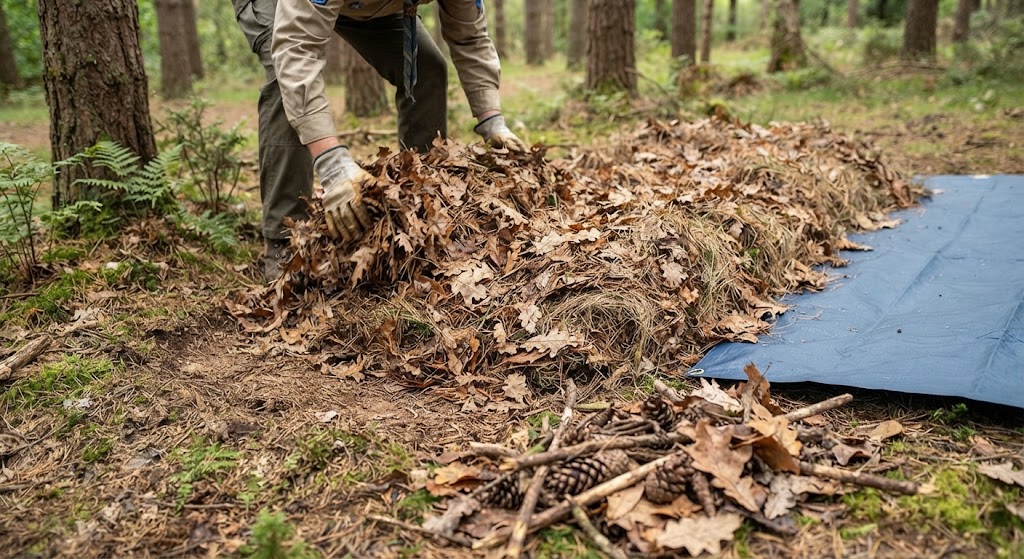
Spread the leaves over a small patch of ground, aiming for an even layer rather than a thin scattering. Gently arrange them so there are plenty of air spaces between the leaves. Avoid stamping them flat, as compression reduces the trapped air that helps provide insulation.
Make the layer broad enough to support your test area. Do not use branches or sharp material that could puncture your mat or cause injury.
Step 4: Set up a fair comparison
Place your groundsheet or sit mat over the leaf layer. If you have a second identical mat, place it on nearby bare ground with similar conditions underneath. Using the same type of mat on both surfaces makes it easier to compare the difference made by the leaves.
If you only have one mat, test the bare ground first and then the leaf layer, keeping the duration and conditions as similar as possible.
Step 5: Test the insulation
Sit or kneel briefly on each setup while wearing the same clothing. Keep the test comfortable and stop immediately if you feel cold, damp or uncomfortable. Never lie on cold ground for an extended period to see how much heat you lose.
Pay attention to the temperature you feel through the mat, how much the layer compresses and whether you can feel hard or uneven ground beneath it. Record your observations rather than relying on memory alone.
Step 6: Check what happens under pressure
After the test, lift the mat and inspect the leaves. Have they flattened into a thin layer, or have they retained some thickness? Compare the area that supported your weight with the surrounding leaves.
This matters because insulation can work well when first laid but become less effective when compressed. A thicker layer may provide more trapped air, but its usefulness depends on the type of leaves, their condition, moisture and how much weight is placed on them.
Step 7: Restore the site
Remove the leaves you gathered and return them to the same general area, provided doing so will not disturb wildlife or spread material into a sensitive habitat. Leave the ground as you found it and take away any equipment or litter.
Check Your Results
Review your observations and answer these questions:
- Did the leaf layer feel warmer than the bare-ground setup?
- Was the difference easy to notice or only slight?
- How much did the leaves compress under your weight?
- Were the leaves dry, damp or partly decayed?
- What difference might a thicker layer make?
- Why would a waterproof groundsheet alone not necessarily provide enough insulation?
Your results may vary with the weather, soil, leaf type and thickness of the layer. A short test cannot measure insulation precisely, but it can help you understand why the material and the condition of the ground matter.
Complete the Challenge
To complete this challenge, you must:
- Gather a small amount of fallen leaves responsibly.
- Build an even, temporary insulation layer.
- Compare it with bare ground using a consistent testing method.
- Record what you noticed about warmth, thickness and compression.
- Restore the area without leaving a trace.
How to Submit Your Challenge
Submit your evidence
- Go to your SGUK member profile.
- Open Social Activity.
- Upload a photograph showing your leaf insulation layer and testing setup to the activity wall.
- Add the hashtag #SGUKChallenge72.
- Share it for verification.
Include a short note explaining how you compared the leaf layer with bare ground and what you observed. You do not need to photograph yourself lying on the ground.
Challenge 72 Checklist
Want to Push Yourself?
Repeat the test with a different permitted type of fallen leaf, or compare a thin layer with a thicker one. Keep the test area and method as similar as possible so you can judge whether the change made a noticeable difference.
Think about how you would combine ground insulation with a suitable sleeping mat, dry clothing and a waterproof shelter on an overnight trip. Natural materials can help you understand insulation, but they are not a dependable substitute for appropriate equipment in cold or wet weather.
What’s Next?
If you haven’t completed SGUK Outdoor Skills Challenge 71: Dry Wet Clothes Beside a Fire Safely, you can try that challenge next. You can complete SGUK Outdoor Skills Challenges in any order, so choose whichever skill you want to develop.
Once you’ve shared your evidence and it has been verified, the SGUK Outdoor Skills Challenge 72 is complete and the completed challenges figure will be updated on your profile.
🔒Ready to test your survival skills?
Join Survival Guides UK for free, complete challenges, earn badges and increase your Survival Level.
JOIN FREE →
CRAIG BURR
FOUNDER · SURVIVAL GUIDES UK
I'm Craig, the person behind Survival Guides UK. I created SGUK because I wanted somewhere people could learn real outdoor skills in a practical, straightforward way — from lighting a fire and tying knots to navigation, campcraft and everything in between.
You can read more about the story behind SGUK here as well as our approach here.