How to Check for Danger and Assess a Casualty
When someone is injured or becomes unwell outdoors, your first instinct may be to rush straight over and help. That is understandable, but the first thing you need to do is stop and check that the situation is safe.
A casualty who needs help is already in a difficult situation, but rushing into danger can create another unneeded casualty. A road, fire, unstable structure, fast-flowing water, falling branches or exposed electrical equipment can all put you at risk as well. The first part of assessing a casualty is therefore assessing the scene.
Start by Checking for Danger
Before approaching, take a few seconds to look around.
Think about what caused the incident and whether that danger is still present. Look for traffic, fire, smoke, unstable ground, falling objects, electricity, water, animals, hazardous substances or anything else that could put you or the casualty at further risk.
You don’t need to identify every possible hazard. You need to decide whether it is safe to approach and what you need to do to make the situation safer.
Don’t Become the Second Casualty
If the area is dangerous, don’t simply walk into it because someone needs help.
For example, if someone has fallen into fast-flowing water, entering the water yourself could put both of you in serious danger. If someone has been injured on a road, moving into traffic without considering your own safety can make the situation worse.
Look for a safer way to help, move people away from danger if it is safe to do so, and call for emergency assistance when necessary.
Get Help Early
If the situation is serious, get help as soon as possible.
Ask someone nearby to call 999 or 112 and give them clear instructions about what you need. If you’re alone and the casualty is unresponsive and not breathing normally, call emergency services and follow the instructions from the call handler.
Don’t assume that someone else has already called. If you need emergency help, make sure the call has actually been made.
Introduce Yourself and Check Responsiveness
If it is safe to approach, go to the casualty and speak to them.
Tell them who you are and ask a simple question such as, “Are you alright?” You can also gently tap their shoulders to see whether they respond, provided there is no obvious reason not to do so.
A person who answers you clearly is conscious and able to respond, although they may still have a serious injury or illness.
If they don’t respond, you need to move quickly to the next part of the assessment.
Check Their Airway
If the casualty is unresponsive, check whether their airway is open.
Look for anything obvious that is blocking the mouth. If there is no indication of a spinal injury, open the airway using the appropriate first-aid technique.
If you suspect a spinal injury, take care to minimise unnecessary movement while still following current first-aid guidance to maintain an open airway.
Check for Normal Breathing
Once the airway is open, check whether the casualty is breathing normally.
Look for normal chest movement, listen for normal breathing sounds and feel for air movement if appropriate. Take no more than about ten seconds to make your assessment.
Gasping, irregular or unusual breaths are not normal breathing. If the casualty is unresponsive and not breathing normally, treat this as a cardiac arrest and begin CPR.
If They Are Not Breathing Normally
Call 999 or 112 and start CPR.
If you have access to an automated external defibrillator (AED), send someone to get it and follow its instructions when it arrives. AEDs are designed to guide you through the process and can be used by members of the public.
If you’re not confident about what to do, the emergency call handler can talk you through CPR while help is on the way.
If They Are Breathing Normally
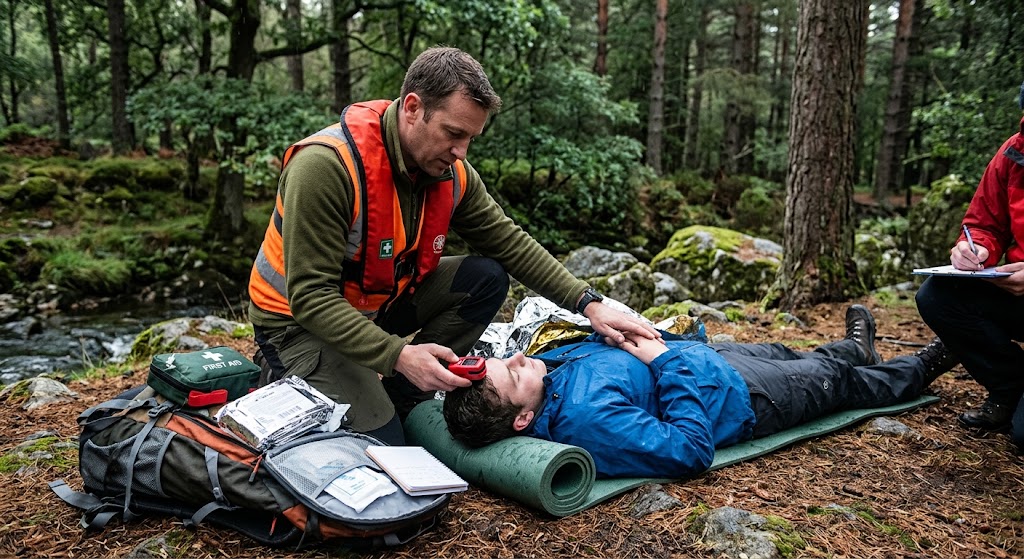
If the casualty is unconscious but breathing normally, they still need urgent attention.
Place them in the recovery position if appropriate and safe to do so, and continue to monitor their breathing. If you suspect a serious spinal injury, follow current first-aid guidance and avoid unnecessary movement unless you need to move them to protect their airway or from an immediate danger.
Do not simply leave an unconscious casualty alone.
Look for Serious Bleeding
Once you have dealt with immediate problems with responsiveness and breathing, look for obvious serious bleeding.
Severe bleeding needs to be controlled quickly. Apply firm direct pressure with a suitable dressing or clean material and maintain pressure. If something is embedded in the wound, do not pull it out; apply pressure around it instead.
If the bleeding is severe or cannot be controlled, call 999 or 112.
Look for Other Obvious Injuries
Once immediate life-threatening problems have been dealt with, look at the casualty more carefully.
Look for obvious injuries such as broken bones, burns, head injuries or wounds. Ask the casualty what happened and where they are hurting if they are conscious and able to answer.
Don’t make them move unnecessarily, particularly if you suspect a significant injury.
Ask Simple Questions
If the casualty is conscious, talk to them calmly.
Ask what happened, where they are hurt and whether they have any medical conditions or take any medication that could be relevant. Their answers can give you useful information about what has happened and whether their condition is changing.
Pay attention to changes in their behaviour as well. Confusion, unusual drowsiness or difficulty speaking can be important signs that something is wrong.
Keep Checking the Casualty
An assessment isn’t something you do once and then forget about.
A casualty’s condition can change, particularly after an injury or if they are becoming seriously ill. Continue to monitor their responsiveness and breathing and watch for changes while waiting for help.
If their condition changes, tell the emergency services.
Keep the Casualty Comfortable
If the casualty is conscious and there is no reason to move them, keep them in a safe and comfortable position.
Protect them from cold, rain and wind where possible without unnecessarily moving them. Reassure them and explain what you’re doing.
Avoid giving food or drink to someone who is seriously injured, drowsy or potentially needing an operation, unless advised to do so by an appropriate medical professional.
Don’t Put Yourself at Risk to Help
Outdoor incidents can involve hazards that aren’t immediately obvious.
A person who has fallen near a cliff edge, into water or onto unstable ground may still be in danger. The safest response may be to keep your distance and call the emergency services rather than attempting a rescue yourself.
Your job as a first aider is to help without becoming another casualty.
Safety When Assessing a Casualty
Remember the basic order:
Danger → Response → Airway → Breathing → Circulation/serious bleeding → Further assessment.
The exact first-aid response will depend on what you find, and current first-aid guidance should always take priority over a memorised acronym. If you’re in doubt about a serious situation, call 999 or 112 and follow the emergency call handler’s instructions.
For outdoor activities, it is particularly important to consider hazards such as traffic, water, fire, unstable ground, weather and remoteness before approaching.
Learn the Skill Before You Need It
First aid is much easier to learn properly in a practical course than from an article alone. If you regularly spend time outdoors, consider taking a recognised first-aid course and practise the basic assessment sequence until it becomes familiar.
You don’t need to know exactly what every injury is before you can help. Being able to recognise danger, check whether someone is responsive, assess normal breathing and get appropriate help quickly can make a real difference.
Stay Calm and Work Through the Assessment
Seeing someone injured can be frightening, particularly when you’re outside and there isn’t immediate medical help nearby. Having a simple process to follow gives you something practical to concentrate on.
First make the scene safe. Then check the casualty’s response and breathing, deal with immediately life-threatening problems, get help and keep monitoring them. You don’t need to diagnose everything yourself; your job is to recognise danger, provide appropriate first aid and get professional help when it is needed.
🔒Ready to test your survival skills?
Join Survival Guides UK for free, complete challenges, earn badges and increase your Survival Level.
JOIN FREE →
CRAIG BURR
FOUNDER · SURVIVAL GUIDES UK
I'm Craig, the person behind Survival Guides UK. I created SGUK because I wanted somewhere people could learn real outdoor skills in a practical, straightforward way — from lighting a fire and tying knots to navigation, campcraft and everything in between.
You can read more about the story behind SGUK here as well as our approach here.