
King Alfred’s Cakes (Daldinia concentrica)
King Alfred’s cakes is a hard, rounded fungus found mainly on dead and decaying ash and beech wood. It starts reddish-brown and darkens with age, and a cross-section reveals distinctive concentric grey and black rings. When completely dry, its inner material can be used as a traditional spark-catching tinder.
- Common name
- King Alfred's cakes
- Alternative names
- Cramp balls, coal fungus, carbon fungus
- Scientific name
- Daldinia concentrica
- Family
- Xylariaceae
- Organism type
- Wood-decaying fungus
- Fruiting body
- Rounded, ball-like or cushion-shaped mass
- Typical size
- Around 2–10 cm across
- Young colour
- Reddish-brown to pinkish-brown
- Mature colour
- Dark brown to black
- Surface
- Hard, often smooth and sometimes shiny when mature
- Interior
- Concentric alternating grey and black layers
- Stem
- No distinct stem
- Gills
- None
- Spore-producing surface
- Tiny openings across the outer surface
- Main host trees
- Ash and beech, with other broadleaf hosts also possible
- Habitat
- Deciduous woodland, dead branches, fallen logs and decaying trunks
- Season
- Fresh growth can appear seasonally; older fruiting bodies persist year-round
- Bushcraft use
- Traditional spark-catching tinder when thoroughly dry
- Burning behaviour
- Can smoulder slowly rather than immediately producing a flame
- Ecological role
- Decomposes dead wood and provides habitat for invertebrates
- Edibility
- Not considered an edible fungus
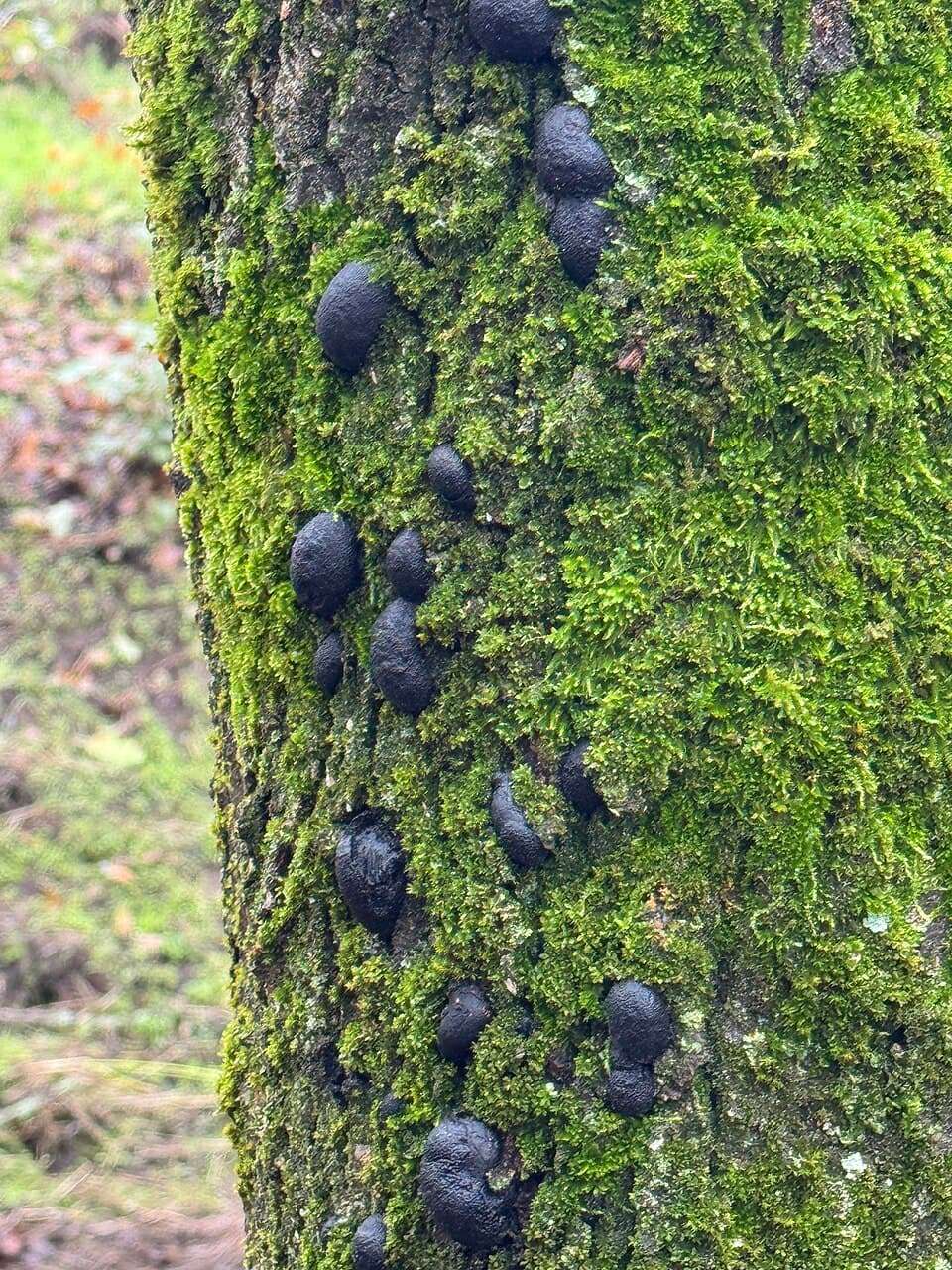
King Alfred’s cakes is a distinctive woodland fungus that grows on dead and decaying wood, particularly ash and beech. Also known as cramp balls, coal fungus and carbon balls, it forms hard, rounded lumps that look rather like pieces of burnt charcoal attached to branches and trunks. The fungus is widespread in Britain and can often be found throughout the year.
Its appearance changes as it matures. Younger fruiting bodies are usually reddish-brown and dull, while older ones become dark brown or black with a hard, sometimes shiny surface. When a mature specimen is cut across, the inside reveals alternating dark and pale grey rings. These concentric layers are one of its most recognisable features and explain the scientific name concentrica.
King Alfred’s cakes is particularly interesting for bushcraft because its completely dry inner material can catch a spark and smoulder slowly. Traditionally, this made it useful for firelighting and carrying an ember. It is not the same as ordinary tinder: the fungus generally smoulders rather than immediately producing a strong flame, so it is normally transferred to suitable fine tinder to establish a fire.
The fungus also plays an important role in woodland ecosystems by breaking down dead wood and providing habitat for small invertebrates. Learning to identify it offers an excellent opportunity to combine fungi identification with practical firecraft and an understanding of deadwood ecology.


Remember: only use fungi you can identify confidently, collect responsibly and follow local rules. You do not need to cut into or remove every specimen you find to learn from it.
Further reading
- Woodland Trust — King Alfred’s cakes
- Plantlife — King Alfred’s cakes
- Kew — King Alfred’s cakes
- Kew — Meet the firestarting fungus
How to Identify it
- Look for rounded growths on wood - The fungus forms hard, rounded or cushion-shaped masses attached directly to dead or decaying wood. It has no conventional mushroom cap or stem.
- Check the colour of younger specimens - Younger fruiting bodies are often reddish-brown or pinkish-brown with a relatively dull surface. Colour varies with age and conditions, so it should not be used alone.
- Examine mature specimens - Older fruiting bodies usually become dark brown to black and develop a hard, coal-like appearance. The surface may be smooth, shiny or cracked.
- Look for concentric rings - The interior reveals alternating dark and pale grey layers, like miniature tree rings. This is a particularly distinctive feature, but cutting should only be considered where collection is permitted and necessary.
- Check for clusters - The fungus may grow singly or in groups along a branch or trunk. Several rounded black growths on the same piece of deadwood are consistent with this species.
- Examine the host wood - Ash is a particularly characteristic host, and beech is also common. The fungus may grow on dead branches, fallen wood and decaying trunks.
- Check for the absence of a stem - The rounded fruiting body attaches directly to the wood. There is no distinct stalk, and the fungus does not have the gills found under many familiar mushrooms.
- Assess the texture - Mature specimens are extremely hard and may feel like small lumps of charcoal. Their durable structure allows them to remain attached to deadwood for a long time.
- Consider the habitat - Search deciduous woodland, especially around fallen ash and beech branches. Fruiting bodies can persist through different seasons, so they are worth looking for throughout the year.
- Confirm the combination of features - Look for the rounded coal-like shape, dark mature surface, absence of a stem, concentric internal rings and growth on broadleaf deadwood. If the features do not fit, leave it unidentified rather than assuming it is King Alfred’s cakes.
Mistakes and Lookalikes
- Dead man’s fingers (Xylaria polymorpha): Usually grows as elongated, finger - like black structures rather than rounded balls.
- Blackening brittle crust (Kretzschmaria deusta): Forms irregular, crust - like patches on wood rather than the typical rounded fruiting bodies of King Alfred’s cakes. This is an important lookalike to recognise.
- Other dark wood - decaying fungi: Some fungi form hard black crusts or rounded growths on deadwood. A black colour alone is not enough to identify this species.
King Alfred’s cakes is a traditional tinder fungus, not a food source. Do not eat it or use it medicinally based on traditional claims.
Collect only where permitted, and avoid removing specimens unnecessarily. Deadwood and fungi provide habitat for woodland wildlife, so leaving them in place is often the best option.
If using a specimen for firelighting, make sure the material is dry and practise in a suitable, legally permitted location. Check for fire restrictions, prepare a safe fire area and keep water or another appropriate means of extinguishing the fire close at hand. Never leave a smouldering fungus or ember unattended, and fully extinguish all material before leaving.